In 2 Samuel 23:8–12 are recorded the names of King David’s mightiest warriors, known simply as “The Three.”
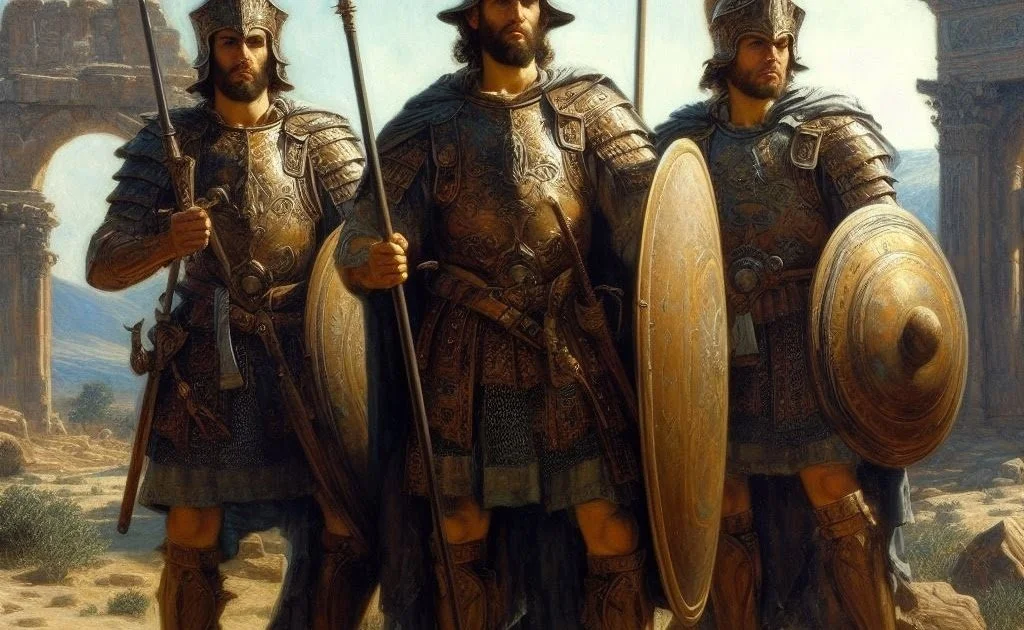
The first was Jashobeam. His name means “the people will return” or “to whom the people will turn.” This indicates reliability. People kept coming back to him because they could count on him. He was a mighty warrior! He once used his spear to kill 800 enemy warriors in a single battle (2 Sam. 23:8).
While our trust is to be ultimately in the Lord and not in men (Psalm 146:3–5; 118:8–9; Jer. 17:5–7; Isa. 2:22), we are to be trustworthy (cf. 1 Cor. 4:2) and surround ourselves with faithful men (2 Tim. 2:2; Ex. 18:21). Jashobeam was the kind of guy folks could count on. Are you?
Next in rank among the Three was Eleazar, whose name means “God is my helper.” David wrote, “Behold, God is my helper; the Lord is the upholder of my life” (Psalm 54:4; cf. Heb. 13:6). When the men of Israel were in a fierce battle, some of them started retreating. But not Eleazar! “He took his stand … and struck down the Philistines, and the Lord worked a great victory” (2 Sam. 23:12).
“For I, the Lord your God, hold your right hand; it is I who say to you, ‘Fear not, I am the one who helps you’” (Isa. 41:13). Does my life, like Eleazar’s name, testify that God is my helper? What mighty exploits do I take on for the Lord—feats that can only be accomplished in His strength? How am I trusting the Lord to help me? Am I seeking Him and His strength continually (Psalm 105:4)?
Shammah was the third warrior mentioned among “the Three.” His name simply means “there,” the implication being “the Lord is there.” It signifies God’s abiding presence, especially as a word of encouragement in difficult times. This is the note on which the book of Ezekiel ends: “And the name of the city from that time on shall be, ‘The Lord is there [Yahweh-Shammah]’” (Ezek. 48:35). Indeed, this is the note on which the whole Bible ends (see Rev. 21–22)!
Oh, that people would see my life, my home, my church, and exclaim, “There! — The Lord is there!”
As we think about the Three, may our thoughts rise to the One — our Lord Jesus! Was there ever a warrior like him? In the closing pages of Scripture (Rev. 19:11-16), the apostle John testifies,
Then I saw heaven opened, and behold, a white horse! The one sitting on it is called Faithful and True, and in righteousness he judges and makes war…. He is clothed in a robe dipped in blood, and the name by which he is called is The Word of God. And the armies of heaven, arrayed in fine linen, white and pure, were following him on white horses…. On his robe and on his thigh he has a name written, King of kings and Lord of lords.
King Jesus is the greater David, and under his direction “like a mighty army moves the church of God.” One day the church militant will be the church triumphant.
In the meantime, may God raise up faithful men who are “good soldiers of Jesus Christ” (2 Tim. 2:3). Like many of David’s mighty men, we may not “attain to the three,” but we can “fight the good fight of faith” (1 Timothy 6:12) and serve “with the strength and energy that God supplies. Then everything you do will bring glory to God through Jesus Christ. All glory and power to him forever and ever! Amen” (1 Peter 4:11 NLT).