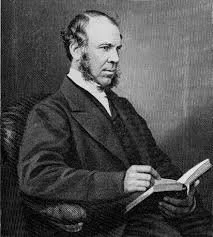
John Charles Ryle, 1860-1900
A few days ago I began reading Christian Leaders of the Eighteenth Century, by J. C. Ryle (1816–1900), an English Anglican bishop, preacher, and writer.
Having just written a brief article on the key features of John MacArthur from the vantage points of those who knew him best, I saw corresponding qualities with the men God used in previous generations. Without further comment of my own, I’ve posted below the observations of J.C. Ryle as he reflected on the revival of Christianity in his own day. I pray that your own heart will be stirred and challenged, as mine was, as you read on.
Who, then, were the reformers of the eighteenth century? To whom are we indebted, under God, for the change which took place?
The men who wrought deliverance for us … were a few individuals, most of them clergymen. … They were simply men whom God stirred up and brought out to do his work…. They did his work in the old apostolic way…. They taught one set of truths. They taught them in the same way, with fire, reality, earnestness, as men fully convinced of what they taught. They taught them in the same spirit, always loving, compassionate, and, like Paul, even weeping, but always bold, unflinching, and not fearing the face of man.
… A candle was lighted, of which we are now enjoying the benefit. … When God takes a work in hand, nothing can stop it. When God is for us, none can be against us.
The instrumentality by which the spiritual reformers of the eighteenth century carried on their operations was of the simplest description. It was neither more nor less than the old apostolic weapon of preaching.
Ryle then proceeds to list four predominant traits of these preachers:
They preached everywhere. If the pulpit of a parish church was open to them, they gladly availed themselves of it. If it could not be obtained, they were equally ready to preach in a barn. … they were instant in season and out of season in doing the fisherman’s work, and compassed sea nd land in carrying forward their Father’s business. … Can we wonder that it produced a great effect?
They preached simply. They rightly concluded that the very first qualification to be aimed at in a sermon is to be understood. They saw clearly that thousands of able and well-composed sermons are utterly useless, because they are above the heads of the hearers. They strove to come down to the level of the people…. To attain this they were not ashamed to crucify their style, and to sacrifice their reputation for learning. To attain this they used illustrations and anecdotes in abundance, and, like their divine Master, borrowed lessons from every object in nature. They carried out the maxim of Augustine — ‘A wooden key is not so beautiful as a golden one, but if it can open the door when the golden one cannot, it is far more useful.’
They preached fervently and directly. They cast aside that dull, cold, heavy, lifeless mode of delivery, which had long made sermons a very proverb for dullness. They proclaimed the words of faith with faith, and the story of life with life. They spoke with fiery zeal, like men who were thoroughly persuaded that what they said was true, and that it was of the utmost importance to your eternal interest to hear it. They spoke like men who had got a message from God to you, and must deliver it, and must have your attention while they delivered it. They threw heart and soul into their sermons, and sent their hearers home convinced, at any rate, that the preacher was sincere and wished them well. They believed that you must speak from the heart if you wish to speak to the heart, and that there must be unmistakable faith and conviction within the pulpit if there is to be faith and conviction among the pews. … Can we wonder that it took people by storm, and produced immense effect?
[Their preaching] was eminently doctrinal, positive, dogmatical, and distinct. … The trumpets which blew down the walls of Jericho gave no uncertain sound. … But what was it that they proclaimed?
For one thing, the spiritual formers of the last century taught constantly the sufficiency and supremacy of Holy Scripture. the Bible, whole and unmutilated, was their sole rule of faith and practice. They accepted all its statements without question or dispute. … To that one book they were content to pin their faith, and by it to stand or fall. This was one grand characteristic of their preaching. They honored, they loved, they reverenced the Bible.
Furthermore, the reformers of the last century taught constantly the total corruption of human nature. Strange and paradoxical as it may seem to some, their first step towards making men good was to show them that they were utterly bad; and their primary argument in persuading men to do something for their souls was to convince them that they could do nothing at all.
Furthermore, the reformers of the last century taught that Christ’s death on the cross was the only satisfaction for man’s sin. and that, when Christ died, he died as our substitute — ‘the just for the unjust.’ … They never taught the modern doctrine that Christ’s death was only a great example of self-sacrifice. They saw in it something far higher, greater, deeper than this. They saw in it the payment of man’s mighty debt to God. They loved Christ’s person; they rejoiced in Christ’s promises; they urged men to walk after Christ’s example. But the one subject, above all others, concerning Christ, which they delighted to dwell on, was the atoning blood which Christ shed for us on the cross.
Furthermore, the reformers of the last century taught constantly the great doctrine of justification by faith. They told men that faith was the one thing needful…. That the moment we believe, we live, and have a plenary title to all Christ’s benefits. Justification by virtue of church membership — justification without believing or trusting — were notions to which they gave no countenance. Everything, if you will believe, and the moment you believe; nothing, if you do not believe — was the very marrow of their preaching.
Furthermore, the reformers of the last century taught constantly the universal necessity of heart conversion and a new creation by the Holy Spirit. They proclaimed everywhere to the crowds whom they addressed, ‘Ye must be born again.’ … The regeneration which they preached was no dormant, torpid, motionless thing. It was something that could be seen, discerned, and known by its effects.
Furthermore, the reformers of the last century taught constantly the inseparable connection between true faith and personal holiness. They never allowed for a moment that any church membership or religious profession was the least proof of a man being a true Christian if he lived an ungodly life. A true Christian, they maintained, must always be known by his fruits; and these fruits must be plainly manifest and unmistakable in all the relations of life. ‘No fruits, no grace,’ was the unvarying tenor of their preaching.
Finally, the reformers of the last century taught constantly, as doctrines both equally true, God’s eternal hatred against sin, and God’s love toward sinners. … They never shrank from declaring, in plainest terms, the certainty of God’s judgment and of wrath to come, if men persisted in impenitence and unbelief; and yet they never ceased to magnify the riches of God’s kindness and compassion, and to entreat sinners to repent and turn to God before it was too late.
These were the doctrines by which they turned England upside down, made ploughmen and colliers [coal miners] weep till their dirty faces were seamed with tears, arrested the attention of peers and philosophers, stormed the strongholds of Satan, plucked thousands like brands from the burning, and altered the character of the age. Call them simple and elementary doctrines if you will. Say, if you please, that you see nothing grand, striking, new, peculiar about this list of truths. But the fact is undeniable, that God blessed these truths to the reformation of England in the eighteenth century. What God has blessed it ill becomes man to despise.