What Only the Christian Can REALLY Know About Suffering - 10 Things (by Reid Ferguson)

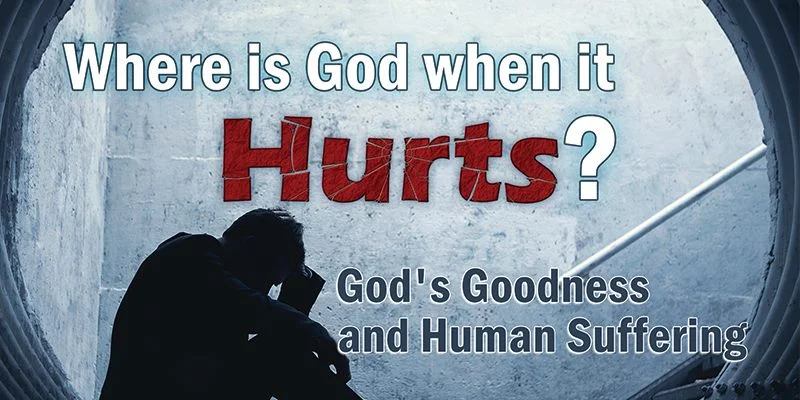
On Saturday, March 30, Webster Bible Church and the Evangelical Church of Fairport (ECF) co-hosted a conference centered on the theme “Where Is God When It Hurts? God’s Goodness and Human Suffering.” All three conference messages, as well as the panel discussion, were outstanding.

Conference Logo.jpg

For the opening session, Pastor Reid Ferguson of ECF set before us a theological framework for suffering based on ten biblical principles. Here they are, along with key biblical references, with no additional comment.

What Only the Christian Can REALLY Know About Suffering (10 Things):

  1. That the entrance of sin is at the root of suffering, and so I kneed to learn a right hatred of it. - Gen. 1-3; Rom. 5:12 (Real Reality)

  2. That if my suffering were really a one-for-one corresponding punishment for sin, I’ve never received the full of what I am due - not even close. - Rom. 6:23; Ps. 73:11-13 (Justice & Mercy)

  3. That a sovereign God is at the helm. - Rom. 8:28; Gen. 50:19 (An Absolute Comfort)

  4. That the enemy may act, but not apart from permission which will eventually work for God’s glory. - Job 1:6 (An Eternal Identity and a Cosmic Conflict)

  5. That I can sanctify and redeem it for the good of the brethren - to comfort others. - 2 Cor. 1:3 (A Magnificent Purpose)

  6. That I can be driven to know God by it in fleeing to Him. - Jer. 29:1-14 (An Unspeakable Privilege)

  7. That for the saved, there is grace in everything. - Ps. 103:10 (A Governing Grace)

  8. That I can learn to crave Heaven by it. - 2 Cor. 4:8-5:6 (A Glorious End)

  9. That I can have an increased gratitude for redemption through it. - 1 Thess. 1:9 (A Sweet Reminder)

  10. That I can enter somewhat into the sweet sufferings of Christ. - Col. 1:24 (A Mysterious Union)

In closing out the conference I sought to answer explicitly the question that had already been answered in all three messages: Where Is God When It Hurts? He (God the Father) is on the throne; He (God the Son) is interceding for us before the throne; He (God the Holy Spirit) is within us fulfilling his role as the Comforter.

“May the God of hope fill you with all joy and peace in believing, so that by the power of the Holy Spirit you may abound in hope.” - Romans 15:13

Don't Be a Hoarder

At times I’m amazed at how the Lord providentially brings together various readings to communicate one unified theme.

This year for my daily quiet time with God, I’m reading through the Bible as well as two additional devotional publications: Tabletalk magazine (by Ligonier Ministries), and Morning by Morning (by Charles Spurgeon).

Today a portion of my Scripture reading included Psalm 40, where David says,

You have multiplied, O Lord my God, your wondrous deeds and your thoughts toward us; none can compare with you! I will proclaim and tell of them, yet they are more than can be told. … I delight to do your will, O my God; your law is within my heart. I have told the glad news of deliverance in the great congregation; behold, I have not restrained my lips, as you know, O Lord. I have not hidden your deliverance within my heart; I have spoken of your faithfulness and your salvation; I have not concealed your steadfast love and your faithfulness from the great congregation. (vv. 5, 8-10)

David doesn’t just take in God’s Word; he talks about it. He tells the congregation about God’s faithfulness, love, and salvation. God calls us to do the same today as his people: “Let the word of Christ dwell in you richly, teaching and admonishing one another in all wisdom, singing psalms and hymns and spiritual songs, with thankfulness in your hearts to God” (Col. 3:16; cf. Eph. 5:18-20). Like David, we are to treasure God’s truth in our hearts, but we’re not to keep it to ourselves; we’re to tell others, too!

That was my main takeaway from this psalm. Then I opened my Tabletalk magazine, and read I read a the weekend devotional by Deepak Reju titled “Weaponize Your Quiet Time.” Deepak writes,

Biblical truth should never be hoarded. To told on to it is selfish. God’s truth was never meant to stop with us. … Let’s strive to take something from our personal study of Scripture and weaponize it. Let us find someone and boldly and graciously hand them truth.

hoarding.jpg

Don’t hoard God’s truth — herald it!

Finally, I turned to Spurgeon’s Morning by Morning and read the opening line for today’s devotional:

No promise is for private application. Whatever God has said to one saint, He has said to all. When He opens a well for one, it is that all may drink.

This truth encourages us in two different ways. First, on the receiving end. What God said to Moses, Abraham, and David, he meant for you and me. “For whatever was written in former days was written for our instruction, that through endurance and through the encouragement of the Scriptures we might have hope” (Rom. 15:4).

Furthermore, we can be encouraged to know that God’s Word for us is also his word for others. The specific application may differ from person to person, but the truth remains the same. So let’s share it!

This can be done through text, social media, and, best of all, personal conversation – especially when the church is gathered each Lord’s Day. Sing God’s Word! Pray God’s Word! Speak God’s Word! That’s how we encourage and build others up in Christ. For it is through the written Word that we meet the living Word, Jesus.

"Though He Died, He Still Speaks": MLK's Letter from a Birmingham Jail

Sad to say, MLK Day is just another holiday to many Americans. To others, it’s an occasion for launching verbal grenades while tucked safely behind a computer. (Often such comments do not arise from personal convictions, but from a perpetual craving to be applauded by one’s own tribe.)

Wouldn’t our time be better spent seeking to understand the heart and soul of MLK’s message to us as his fellow Americans — especially on this day that has been set aside to honor his legacy? Why not take a few quiet moments to read his Letter from a Birmingham Jail and plead to the Lord for “justice [to] roll on like a river, righteousness like a never-failing stream!” (Amos 5:24).

MLK Facial Sketch.jpg

If you’re not familiar with Martin Luther King, Jr., I would encourage you to read the brief biographical sketch provided on The Nobel Prize website. Here you’ll find, among other fascinating facts, that “Martin Luther King, Jr., was the youngest man to have received the Nobel Peace Prize. When notified of his selection, he announced that he would turn over the prize money of $54,123 to the furtherance of the civil rights movement.”

“On the evening of April 4, 1968, while standing on the balcony of his motel room in Memphis, Tennessee, where he was to lead a protest march in sympathy with striking garbage workers of that city, he was assassinated.”

Today I took some time to read MLK’s Letter from a Birmingham Jail, which he wrote in 1963 — one hundred years after President Abraham Lincoln issued his Emancipation Proclamation. The purpose of the letter was to respond to the questions and criticisms of white clergy who publicly challenged MLK’s tactics of nonviolent civil disobedience. Listed below are some quotes I pulled from the letter as I pored over it. Please take the time to read MLK’s letter in its entirety, for the sake of hearing its message and honoring the martyr who wrote it.

Injustice anywhere is a threat to justice everywhere. We are caught in an inescapable network of mutuality, tied in a single garment of destiny. Whatever affects one directly, affects all indirectly.

For years now I have heard the word "Wait!" It rings in the ear of every Negro with piercing familiarity. This "Wait" has almost always meant "Never." We must come to see, with one of our distinguished jurists, that "justice too long delayed is justice denied."

An unjust law is a code that a numerical or power majority group compels a minority group to obey but does not make binding on itself. This is difference made legal. By the same token, a just law is a code that a majority compels a minority to follow and that it is willing to follow itself. This is sameness made legal.

Shallow understanding from people of good will is more frustrating than absolute misunderstanding from people of ill will. Lukewarm acceptance is much more bewildering than outright rejection.

Like a boil that can never be cured so long as it is covered up but must be opened with all its ugliness to the natural medicines of air and light, injustice must be exposed, with all the tension its exposure creates, to the light of human conscience and the air of national opinion before it can be cured.

We will have to repent in this generation not merely for the hateful words and actions of the bad people but for the appalling silence of the good people.

Human progress never rolls in on wheels of inevitability; it comes through the tireless efforts of men willing to be co workers with God, and without this hard work, time itself becomes an ally of the forces of social stagnation. We must use time creatively, in the knowledge that the time is always ripe to do right.

I am grateful to God that, through the influence of the Negro church, the way of nonviolence became an integral part of our struggle. If this philosophy had not emerged, by now many streets of the South would, I am convinced, be flowing with blood. And I am further convinced that if our white brothers dismiss as "rabble rousers" and "outside agitators" those of us who employ nonviolent direct action, and if they refuse to support our nonviolent efforts, millions of Negroes will, out of frustration and despair, seek solace and security in black nationalist ideologies--a development that would inevitably lead to a frightening racial nightmare.

But though I was initially disappointed at being categorized as an extremist, as I continued to think about the matter I gradually gained a measure of satisfaction from the label. Was not Jesus an extremist for love: "Love your enemies, bless them that curse you, do good to them that hate you, and pray for them which despitefully use you, and persecute you." Was not Amos an extremist for justice: "Let justice roll down like waters and righteousness like an ever flowing stream." Was not Paul an extremist for the Christian gospel: "I bear in my body the marks of the Lord Jesus." Was not Martin Luther an extremist: "Here I stand; I cannot do otherwise, so help me God." And John Bunyan: "I will stay in jail to the end of my days before I make a butchery of my conscience." And Abraham Lincoln: "This nation cannot survive half slave and half free." And Thomas Jefferson: "We hold these truths to be self evident, that all men are created equal . . ." So the question is not whether we will be extremists, but what kind of extremists we will be. Will we be extremists for hate or for love? Will we be extremists for the preservation of injustice or for the extension of justice? In that dramatic scene on Calvary's hill three men were crucified. We must never forget that all three were crucified for the same crime--the crime of extremism. Two were extremists for immorality, and thus fell below their environment. The other, Jesus Christ, was an extremist for love, truth and goodness, and thereby rose above his environment. Perhaps the South, the nation and the world are in dire need of creative extremists.

In deep disappointment I have wept over the laxity of the church. But be assured that my tears have been tears of love. There can be no deep disappointment where there is not deep love. Yes, I love the church. How could I do otherwise?

So often the contemporary church is a weak, ineffectual voice with an uncertain sound. So often it is an archdefender of the status quo. Far from being disturbed by the presence of the church, the power structure of the average community is consoled by the church's silent--and often even vocal--sanction of things as they are.

Let us all hope that the dark clouds of racial prejudice will soon pass away and the deep fog of misunderstanding will be lifted from our fear drenched communities, and in some not too distant tomorrow the radiant stars of love and brotherhood will shine over our great nation with all their scintillating beauty.
FaceTime with Jesus

“Absence makes the heart grow fonder.” Ever heard of that line?

Or how about, “Out of sight, out of mind.” That sort of suggests the opposite, doesn’t it?

Either statement can be true, depending on the subject at hand.

In my case I’m thinking about our daughter Megan, who along with her husband and our two grandchildren, moved over a thousand miles away from us a few weeks ago. Prior to their departure, they lived ten minutes from us and even stayed with us their final month here. We got to wake up with our grandkids on Christmas morning!

But after New Year’s they moved away.

Living away from family is hard, but it’s even tougher when you’ve been together for so long.

Yep. Absence indeed makes the heart grow fonder.

Now we communicate with them through phone, text, and FaceTime. That last mode of communication is my favorite. The other day when my wife and I called our grandkids Ivy (3) and Ezra (1), and our faces popped up on the screen, they gave us big smiles. Ezra reached out to give me a hug, but the best I could do was wave and blow him kisses.

In that moment I was reminded that while modern technology is great, seeing each other is not the same as being with each other.

FaceTime.jpg

This reality made me think of what it must have been like for the disciples when Jesus returned to heaven. No wonder they kept gazing into heaven after a cloud took him out of their sight (Acts 1:9-10), just as I kept looking down the road after my family drove off, until I couldn’t see them anymore.

I’m not sure when I’ll see them again in person, but in the meantime I’ll enjoy seeing them on FaceTime.

That’s kind of how Scripture works as it relates to Jesus. In 2 Corinthians 3:18, the apostle Paul says that as God’s children, we have nothing obstructing our vision of Christ and his glory as revealed in Scripture. Paul says it’s like looking in a mirror. Not so much the reflective capabilities of the mirror as the intimacy of it. We can hold a mirror right up to our face and get an unobstructed view.[1]

That’s a beautiful thing when it comes to seeing Jesus.

Even so, seeing Him is not the same as being with Him. That’s why Paul wrote, “My desire is to depart and be with Christ, for that is far better” (Phil. 1:23).

Likewise, Peter encouraged his fellow Christians who had never met Jesus in person, saying, “You love him even though you have never seen him [in person]. Though you do not see him now, you trust him; and you rejoice with a glorious, inexpressible joy” (1 Pet. 1:8 NLT).

Seeing Jesus isn’t the same as being with Jesus. But we can enjoy Facetime (or shall we call it FaithTime?) with Jesus in Scripture until we live with him forever in heaven.

Makes you kind of homesick, doesn’t it?


        [1] John MacArthur, The MacArthur Bible Commentary (Nashville: Thomas Nelson, 2005), p. 1624.

Those Blasted, Born-Again Christians!

Today at my physical therapy session, I overheard the lady next to me express her annoyance to a staff member at “those born-again Christians.” I caught only the tail end of the conversation, when she said, “They’re all a bunch of Trump-supporters and are always trying to push their religion on me. Well, I’m Catholic, and I can’t stand Trump! Why can’t they just keep their opinions to themselves? I make it my business never to discuss religion or politics!”

I couldn’t help but grin at the irony. She never discusses religion or politics, yet within the first ten seconds of hearing her voice, I knew she’s Catholic, anti-Trump, and can’t stand born-again Christians!

At that point she got up and left, and the therapist (who claims to be a Christian) worked on me a few minutes. Afterwards, I went to the facility next door to continue my personal exercise/therapy routine. I opened the door, and … can you guess who was the only other person in the room? Yep, that’s right — the cantankerous Catholic lady!

As I finished up my routine, I introduced myself to her and said, “I couldn’t help but overhear your conversation next door. Would you mind telling me why born-again Christians bother you so much?”

The lady, whom I’ll call Mary, replied, “Well, for one thing, I had a former student invite me and some other neighbors over, and he started talking to us about Jesus! A bunch of my husband’s co-workers are also born-again Christians, and they’re always inviting him to a Bible study – trying to get him to come over to their side! If that weren’t enough, one born-again lady told a friend of mine that she wouldn’t bowl with me because I was a bad person!”

Slide1.jpg

The more she talked, the more I could see that she had adopted an “us versus them” mentality when it came to Catholics and “born-again Christians.” Plus, she was convinced that virtually all born-again Christians were Trump supporters. (Note: According to a Lifeway Research report released last year, 56 percent of born-again Americans identify as Republicans while 39 percent identify as Democrats.)

Taking Mary’s words at face value, and believing the best about her (as love seeks to do, 1 Cor. 13:7), I responded by saying,

Mary, I’m sorry you’ve had bad experiences with born-again Christians. Some folks who wear that label don’t live it out by loving others as they should. Jesus was a friend of sinners. By the way, it was Jesus himself who said, “You must be born again.” So the term itself isn’t bad; it comes straight from the Bible. By the way, Mary, I want to give you full disclosure: I am the pastor at Webster Bible Church here in town. I am not Catholic, but I also realize that the term “born-again Christian” has become a broad label and even a political identity of sorts. That’s unfortunate. If you’re open to further conversation, I’d like to discuss what it truly means to be born again, according to Jesus.

As it turns out, Mary comes in every Tuesday at the same time I do. So I hope to share the gospel with her soon. Please pray that God would give me an open door, and Mary an open heart.

In thinking about Mary’s past experience and our conversation today, the words of the late Baptist preacher, Sumner Wemp, came to mind: “If the gospel is an offense, praise God. If I’m an offense, that’s sin.”

I’m thankful for the boldness of believers to share their faith in Christ. But we are also told to do so in a wise and winsome manner. Scripture says, “Walk in wisdom toward outsiders, making the best use of the time. Let your speech always be gracious, seasoned with salt, so that you may know how you ought to answer each person” (Col. 4:5-6).

Remember, too, that politics are not part of the gospel. So don’t mix the two. Otherwise, you will build a barrier that the gospel is meant to break down.

Thoughts? Comments?

The Lord's Supper: A Serious Celebration

John Newton, the slave-trader turned hymn-writer, experienced the transforming power of the gospel and wrote about it in his most famous hymn, Amazing Grace. That theme dominated his life, as evidenced by his preaching, praying, and writing.

In another hymn, titled In Evil Long I Took Delight, Newton reflected on his pre-conversion days, how he lived recklessly for his own pleasure until God mercifully saved him. As he pictured Jesus hanging on the cross “in agonies and blood,” Newton felt a mix of emotions known to many of us when meditating on the cross: 

With pleasing grief and mournful joy,
My spirit now is filled,
That I should such a life destroy,
Yet live by him I killed.

That’s how we should feel every time we partake of the bread and cup: pleasing grief and mournful joy. Not grief without joy, or pleasure without mourning, but a mix of both sorrowful reflection and heartfelt rejoicing.

Furthermore, there's both an individual and a corporate dynamic to the Lord's Supper. As we look at Scripture, particularly First Corinthians, we learn that communion is a time for both individual self-examination ("Let a person examine himself" - 1 Cor. 11:28) and communal celebration ("Christ, our Passover lamb, has been sacrificed. Let us therefore celebrate the festival” - 1 Cor. 5:7-8).

Communion 1 copy.jpg

Maintaining this balance is a challenge for every church. Some churches are big on celebration but weak on self-examination. Other churches stress self-examination to the neglect of celebration -- at least during their observance of the Lord’s Supper. Some church members look like they're attending a funeral -- as if Jesus were still dead! (J. A. Medders has written about this rather bluntly in his article, The Lord’s Supper Isn’t a Funeral Meal.)

Our pastoral staff, in conjunction with our music team, strives to help our congregation to maintain a spirit of “pleasing grief” and “mournful joy” as we partake of the Lord's Supper. Practically speaking, we tend to include both soft instrumental music for the sake of personal reflection, and also congregational singing to celebrate our unity in Christ. Our hope is that an appropriate blend of gospel-centered songs, combined with scriptural teaching and exhortation, will help us as a church to strike a healthy balance between individual self-examination and communal celebration

If you have any personal insights or practical suggestions you'd like to share, please do so in the Comments section below. I'd love to hear from you.

Roof Repair and Soul Care: Five Similarities

The flat, rubber roof on top of our worship center is in need of major repair. Thankfully, it doesn't need to be altogether replaced, but significant work needs to be done. To save money, we're trying to do most of the labor in-house. As a team of us were working on the roof yesterday afternoon, it dawned on me that roof repair and soul care have much in common. Below are five similarities that came to mind:

Roof Repair.jpg
  1. Clues - We noticed there was a problem when water began leaking into the sanctuary. Even though the water was the presenting problem, it wasn't the primary problem. The presenting problem could be solved by putting out buckets, but to fix the primary problem, we had to repair the roof. Likewise, words and behavior present clues that there's a deeper problem in the heart that needs to be addressed (see Matthew 12:33-35; Mark 7:20-23).
  2. Crust - After removing the layer of rocks on the rubber roof, we noticed that there was a crust of silt covering the rubber membrane. This crust had built up over time and needed to be scrubbed off before any protective covering could adhere to the membrane. It wasn't easy getting through that hard external covering. We had to scrub, scour, rinse, and repeat. Some spots were harder than others and required a lot more attention. Likewise, the human heart can become encrusted by resentment and bitterness, unresolved conflict, emotional scars and such. There are no quick fixes in such cases. Spiritual cleansing requires a lot of time and painstaking effort. But the Word of God, rightly administered, can penetrate the hardest of exteriors and get to the heart of the matter (Hebrews 4:12).
  3. Care - While working to get the crust off the roof, we had to be careful not to damage the membrane itself. So while being conscientious, we also had to be careful. The same is true when addressing heart issues. Our goal is to kill sin without doing unnecessary damage to the spirit. "There is one whose rash words are like sword thrusts, but the tongue of the wise brings healing" (Proverbs 12:18). 
  4. Collaboration - Repairing a roof is a daunting task and can be a bit overwhelming if you attempt to do it alone. That's why there are roofing crews. There is strength in numbers! Scripture says, "Two are better than one, because they have a good reward for their labor" (Eccl. 4:9). The same is true in counseling. While one person is talking, the other counselor can be praying silently, taking notes, or picking up on non-verbal cues from the counselee. Beyond the structured session itself, all believers should be counseling one another in a general sense. They have the two essentials for doing so: the Word of God and the Spirit of God. In writing to a local church, Paul confidently stated, "I myself am satisfied about you, my brothers, that you yourselves are full of goodness, filled with all knowledge and able to instruct one another" (Romans. 15:14). 
  5. Cost - Our roofing project here at church is costing us thousands of dollars and hundreds of volunteer man-hours (and woman-hours!). Yet our congregation believes this project is worth it, because they rightly see our building as a stewardship that God has entrusted to us. If that's true of a building, how much more so of believers, who are "like living stones ... being built up as a spiritual house" (1 Peter 2:5), "a dwelling place for God" (Eph. 2:22), i.e. "God's temple" (1 Cor. 3:16). Biblical counseling, done rightly, requires a significant investment of time, money, volunteers, and other resources in the church. But the benefits far exceed the cost as lives are changed by the power of the gospel, and the church "grows into a holy temple in the Lord" (Eph. 2:21). 

God's People and Good Works

In his commentary on Titus 3:1-8, John Stott points out that the apostle Paul uses the expression "good works" (kala erga) fourteen times in the pastoral epistles (1 & 2 Timothy and Titus). That's quite a few occurrences, considering the brevity of these letters. But Paul is conveying to pastors the vital role of good works in the lives of God's people. Indeed, Paul tells Titus, "I want you to insist on these things, so that those who have believed in God may be careful to devote themselves to good works" (Titus 3:8). 

Good_Works.png

Having considered all fourteen occurrences of "good works" in the Pastorals, Stott concludes that Paul seems to be emphasizing five points:

  1. The very purpose of Christ's death was to purify for himself a people who would be enthusiastic for good works (Titus 2:14).
  2. Although good works can never be the basis of salvation (Titus 2:5; 2 Tim. 1:9), they are the essential evidence of salvation (Titus 3:8, 14).
  3. It is therefore expected that all Christians will be "equipped" and "eager" to do good works (2 Tim. 2:21; 3:17; Titus 3:1; cf. 1 Tim. 2:10; 5:10; 6:18).
  4. Since pastoral oversight is itself a good work (1 Tim. 3:1), all Christian leaders should be conspicuous (easily recognizable) by the good works they do (1 Tim. 5:25; Titus 2:7). This behavioral pattern stands in contrast to the false teachers who "claim to know God, but ... deny him by their works" (Titus 1:16).
  5. It is above all by good works that the gospel is adorned (made to look attractive) and so commended to outsiders (Titus 2:9-10; cf. Titus 2:5).

No wonder God's people should "be careful to devote themselves to good works. These things are excellent and profitable for people" (Titus 3:8).

What good works will you do today?

No Time to Burn

If you want to know how fast time flies, talk to an octogenarian. That's what I did today when my dad called to share a poem that he wrote over 40 years ago, when he was ten years younger than I am now. At the time, my dad had been married just a decade and had five children, all under the age of ten. While holding down a full-time job, he had just completed multiple years of night school to earn his M.B.A. and had undergone six intense weeks of study to pass his C.P.A. exam. 

With all this formal education now behind him, Dad thought that he would have "time to burn." But life taught him otherwise. How thankful I am that my father learned this lesson early on, because time is one commodity you can't get back once you spend it.  "Pay careful attention, then, to how you live—not as unwise people but as wise — making the most of the time...." (Ephesians 5:15-16).

No Time to Burn

By: James W. Fletcher

With years of study now behind,
I felt so certain I would find
That I’d have extra time galore
And not be busy anymore.

But still, each evening’s spoken for,
And weekends crowded even more
With things that clamor for my time;
(It took an hour for just this rhyme.)

The kids all need some time from Dad
For things they’ve never really had,
Like fishing trips and woodland hikes,
And fixing up their little bikes.

And Bev, for all her married life,
Has been an oft neglected wife.
She’s had her share of gifts and flowers,
But far too few of husband’s hours.

Our church continues in its need
For workers who will sow the Seed,
And visit door-to-door at night
To share with folks the Gospel light.

To meet these needs, and many more,
I’m just as busy as before;
There’s more to do than hours permit,
And there’s no time to idly sit.

But I have found, to my surprise:
I wouldn’t want it otherwise.
It took nigh forty years to learn
There’s no such thing as “time to burn.”

Hourglass.jpg

To Post or Not to Post: That Is the Question

Let's be honest: Most of us tend to put our best foot forward on social media. Including me.

Does that make us hypocrites?

Hypocrisy.jpg

Maybe. Maybe not. It depends on our motives. If we're presenting ourselves as something different than we really are, then that's hypocrisy. If we're simply wanting the approval and affirmation of others, then that's vanity. 

But if we're trying to encourage others and point them to Jesus -- despite our own imperfections -- then that's commendable.

The problem is that "the human heart [the seat of our thoughts, desires, and motives] is the most deceitful of all things, and desperately wicked. Who really knows how bad it is?" (Jer. 17:9 NLT). The answer is: Nobody except the Lord. Even someone as godly as the apostle Paul confessed, "My conscience is clear, but that does not make me innocent. It is the Lord who judges me" (1 Cor. 4:4 NIV). 

So we, like Paul, should do our best to examine ourselves and maintain a clear conscience before God and all people (Acts 24:16). At the same time, we must also be careful not to let critics keep us from using social media as a platform for doing a lot of people a lot of good.

Some professing Christians never post any Scripture or anything pertaining to the Lord online. They also never "like" such posts by other people. Instead, they criticize and accuse them of trying to appear "spiritual" so that others will admire them. The same people that hurl such accusations take pride in the fact that they never post such things because they're not hypocrites.

If that's you, well then, congratulations. That makes you guilty of one less sin. You can even thank God for that. May I suggest beginning your prayer this way: "God, I thank you that I am not like other men..." -- just like the Pharisee did (Luke 18:11). 

What do you expect people to do -- hang out all their dirty laundry so that everyone can see how "real" they are? Going back to Paul, I don't see him doing that in Scripture. Although he was quick to acknowledge that he was the foremost sinner (1 Tim. 1:15) and that he struggled greatly with sin (Rom. 7:14-25), Paul spent most of his time instructing people in the way of the Lord. If Paul were alive and on social media today, I don't think he would post things like:

  • I just lusted after a gorgeous babe who walked by.
  • You wouldn't believe the cuss word I just uttered under my breath!
  • I couldn't help but laugh at this dirty joke I heard.....

No, Paul was honest about his sin but spent the bulk of his time building people up in the Lord. He chose to focus on God's greatness rather than his own sinfulness.

Furthermore, there's a difference between posting, "During my hour-long devotions this morning at 5:00 a.m., here's a verse the Lord gave me..." versus posting a Scripture verse with a few thought-provoking comments that the Lord genuinely impressed on your heart and that you believe will also encourage others. There's a difference between constantly posting selfies to draw people's attention to yourself versus posting Scripture to draw people's attention to the Lord.

Again, I realize that the latter action can still be fueled by the same sinful motives as the former. But doesn't love believe the best about others and give them the benefit of the doubt (1 Cor. 13:7)? And aren't we as Christians to avoid speaking evil against one another and judging one another (James 4:11-12)? 

Oops, there I go again, quoting Scripture. I must be a hypocrite!

Perhaps it would be better to post only silly, trivial stuff -- or better yet -- incendiary comments and articles that get people all fired up and throwing stones at one another. Why build people up when you can tear them down or get them to tear each other apart? Why direct their thoughts toward God when I can fill their minds with frivolous, superficial things?

Sorry, but that makes no sense to me. There are already countless people providing that sort of substance (or lack thereof) on social media. 

I don't want to be hypocritical or come across as "hyper-spiritual." I'm also acutely aware of my desire for other people's affirmation and approval. But I'd rather examine my conscience and run the risk of being judged by others, than to let my sinful inclinations or theirs prevent me from pointing people to Jesus.

Shoe-Leather Love

Last Sunday I preached on the spiritual disciplines (Bible reading, prayer, fasting, exercising faithful stewardship, serving in the local church, evangelizing the lost, etc.). A few days later I saw on the bookshelf in our family room a book by Jerry Bridges that I read years ago, titled The Discipline of Grace: God's Role and our Role in the Pursuit of Holiness. I picked up the book and began reading it with a desire to refresh my own understanding of how grace fuels sanctification (the process of becoming less sinful and more like Jesus). As Bridges puts it,

Your worst days are never so bad that you are beyond the reach of God's grace. And your best days are never so good that you are beyond the need of God's grace.

That's a foundational principle -- not only to Bridges' book but to all of Christian living. The transforming effects of the gospel impacts every aspect of life, including our relationships. After all, Jesus did say that to love God supremely with our entire being and to love our neighbor as ourselves are the first and second commands (Matt. 22:37-39). The apostle Paul reinforced this concept when he wrote, 

Therefore be imitators of God, as beloved children. And walk in love, as Christ loved us and gave himself up for us, a fragrant offering and sacrifice to God. (Eph. 5:1-2)
WalkInLoveSandal.jpg

The command to "walk in love" emphasizes the practical nature of this supreme virtue. In 1 Corinthians 13, Paul lists some of the "active ingredients" of love, saying, 

Love is patient, love is kind. It does not envy, it does not boast, it is not proud. It does not dishonor others, it is not self-seeking, it is not easily angered, it keeps no record of wrongs. Love does not delight in evil but rejoices with the truth. It always protects, always trusts, always hopes, always perseveres.

To help him put "shoe leather" on the concept of love, Jerry Bridges paraphrased the above verses into action statements. I found these to be very helpful, especially in light of the gospel-centered motives that produce such action.

  • I am patient with you because I love you and want to forgive you.
  • I am kind to you because I love you and want to help you.
  • I do not envy your possessions or your gifts because I love you and want you to have the best.
  • I do not boast about my attainments because I love you and want to hear about yours.
  • I am not proud because I love you and want to esteem you before myself.
  • I am not rude because I love you and care about your feelings.
  • I am not self-seeking because I love you and want to meet your needs.
  • I am not easily angered by you because I love you and want to overlook your offenses.
  • I do not keep a record of your wrongs because I love you, and "love covers a multitude of sins."

How are you doing in your day-to-day practice of love? Is there any room for self-righteousness? Indeed, we all fall short of God's standard. That's why we need his grace. (Refer again to Bridges' quote at the top of this article!) Let's ask the Lord to renew our hearts and to help us put on love's walking shoes!

LoveSneakers.jpg

What Is Godliness?

To enhance my summer reading, I've joined Tim Challies' group, Reading Classics Together We'll be going through The Godly Man's Picture by Thomas Watson. As Challies points out, this book is not just for men. "It is, in reality, The Godly Person's Picture and simply looks to Scripture to describe the marks of a Christian." 

(Note: If you'd like to join the reading group, click here.)

I just began reading the book myself. Today I leafed through chapter two, which asks, What is godliness? 

Watson provides the following answer: "Godliness is the sacred impression and workmanship of God in a man...." That's a simple definition, but Watson enlarges our understanding of godliness by laying down seven maxims, which I'll comment on briefly, mixing my own remarks with Watson's:

  1. Godliness is a real thing, it is not shadow, but substance. It's not the figment of a deluded person's imagination. Rather, it has truth as its foundation (Psalm 86:11). If God be true, then godliness is true.
  2. Godliness is an intrinsical thing; it lies chiefly in the heart (Psalm 51:6). "The dew lies on the leaf, the sap is hid in the root. The moralist's religion is  all in the leaf, it consists only in externals: but godliness is a holy sap which is eradicated in the soul."
  3. Godliness is a supernatural thing, whereas by nature, we inherit nothing but evil. We naturally crave sin, sucking it in like a baby does her mother's milk. But godliness is "breathed in from heaven. God must light up the lamp of grace in the heart; weeds grow of themselves, flowers are planted." Isaiah refers to godly people as "oaks of righteousness, the planting of the Lord, that he may be glorified" (Isa. 61:3).
  4. Godliness is an extensive thing; it is a sacred leaven that spreads itself throughout the whole person (1 Thess. 5:23). Says Watson, "Grace is called the new man (Col. 3:10), not a new eye or tongue, but a new man; he who is godly is good all over; tho' he be regenerate but in part, yet it is in every part."
  5. Godliness is an intense thing; it does not lie in a dead formality or indifference, but is "fervent in spirit" (Rom. 12:11). A godly heart boils over in holy affections.
  6. Godliness is a glorious thing; as the jewel is to the ring, so is piety to the soul. "Godliness is near a kin to glory (2 Pet. 1:3)... Godliness is glory in the seed, and glory is godliness in the flower."
  7. Godliness is a permanent thing. "Godliness is a fixed thing: there is a great deal of difference between a stake in the hedge and a tree in the garden; a stake rots ... but a tree, having life in it, abides and flourisheth." Scripture declares, "No one born of God makes a practice of sinning, for God's seed abides in him..." (1 John 3:9) - and it abides to eternity.

In thinking on these qualities, we may be inclined to cry out with David, "Help, O Lord, for the godly are fast disappearing! The faithful have vanished from the earth!" (Psalm 12:1 NLT). Yet the Holy Spirit responds, "what kind of people ought you to be? You ought to live holy and godly lives" (2 Pet. 3:11). Yes, we should. Indeed, we can! "For God is working in [us] giving [us] the desire and the power to do what pleases him" (Phil. 2:13).

So, join us in this quest for godliness!